I'm sitting in Second Cup, and I needed somewhere to plug my laptop in. The only socket near me was fully occupied. One outlet was being used by another girl's laptop, and the other outlet had the obligatory table-top Christmas tree plugged into it. Now, as mesmerizing as it was to stare into the ever-changing fibre-optic tree, I needed to work. So I unplugged the tree and plugged in my powerbook.
The girl with the laptop looked at me, smiled, and said "You just ruined Christmas for everyone"
I was bursting with laughter inside, but I merely smiled back and said to her "Oh well, I need to study."
How wonderful is it that I unplugged the Supreme Christian Religious Icon so that I would be able to study for my Rabbinic Judaism midterm tommorow. This could be more than a funny coincidence. It could be a supreme sign. Should the Jewish people somehow dramatically and surprisingly increase in size so as to dwarf Christianity sometime in the near future, everyone take note: IT WAS I THAT WAS RESPONSIBLE.
I'm not saying I'm the Messiah. I'll leave that to Dan Bern.
I'm not going to do a whole social commentary on this. I'm just going to leave it pure and enjoyable. Smiling, I'm going to go study Saadiah Gaon while the Nutrcracker plays overhead.
Wednesday, November 30, 2005


Tuesday, November 29, 2005
so inspired
Sitting in my Theatre of the Holocasust right now.
So very much inspired.
The teacher of the class is a theatre mother. Not like a snobby "drama mom" but truly, a mother to all of us in the theatre. She's taken care of us this term as we've dealt with a very sensitive subject. It has been amazing to learn with her.
My director right now is incredible - organic, inspiring, inspired, funny, wise... such a pleasure to work with her.
Tonight, I got offered a fantastic opportunity to star in a play being written by the head of the theatre department.
In spite of the three exams and one essay I have on my mind, today has been an incredibly refreshing day.
Wow.
So very much inspired.
The teacher of the class is a theatre mother. Not like a snobby "drama mom" but truly, a mother to all of us in the theatre. She's taken care of us this term as we've dealt with a very sensitive subject. It has been amazing to learn with her.
My director right now is incredible - organic, inspiring, inspired, funny, wise... such a pleasure to work with her.
Tonight, I got offered a fantastic opportunity to star in a play being written by the head of the theatre department.
In spite of the three exams and one essay I have on my mind, today has been an incredibly refreshing day.
Wow.
Saturday, November 12, 2005

Yeah, I guess you could say so...
| Your Birthdate: September 15 |
 You take life as it is, and you find happiness in a variety of things. You tend to be close to family and friends. But it's hard to get into your inner circle. Making the little things wonderful is important to you, and you probably have an inviting home. You seek harmony with others, but occasionally you have a very stubborn streak. Your strength: Your intense optimism Your weakness: You shy away from exploring your talents Your power color: Jade Your power symbol: Flower Your power month: June |
Wednesday, November 02, 2005
Amichai poem that describes Israel well--
(Excuse me, this fell. Is it yours?
The stone? Not this, this fell
nine hundred years ago.)
The stone? Not this, this fell
nine hundred years ago.)
Theresa Tova...Wow
Theresa Tova, the playwright of "Still the Night" came and visited with my Theatre of the Holocaust class this evening. I'm not sure I can manage to explain what just happened this evening, I need to let the experience sink in. In brief:
Laughing/crying/swearing/shouting/whispering/SINGING(in Yiddish!)/drawing us in... her emotions were seamless as she flowed through the text, to the music, to the stage directions, to telling us stories, then back to the play, then filling us in on secrets... all the while bringing each one of us into her life - at one point actually physically taking one of us in.
At one point she got so intense that she dropped her play on the ground. What a moment - for her to be so into the text, that she dropped the physical text on the ground and leapt away.
Words cannot describe the experience we all got to share, but seeing as this is a journal... words are all I can use. So here are some of her words from tonight. I'll start off with my favourite:
"Your truth, as specific as it is to you, universal. You've got to know that. As long as you're true"
"When you're in love, the whole world is Jewish"
"If you do correct grammar and put a Yiddish accent on it, you sound like Neil Simon"
"She never stopped fighting the war" ~ on her mother
"You can't control your parents or the press"
"Ooo he's so frustrating but he's so magical" ~ on Brent Carver
"I don't care that Hitler fucked you up... I want to choose life... I will not hide who I am" ~ to her mother.
"Let's not do the 'poor us, poor victims'. It's not about that anymore... this girls were fighters!"
How did she write her play?
"My work has to come from something I know"
"I just sit in my mothers vibe... I'm fine!"
"I sat with a bottle of brandy for three months at the computer"
Laughing/crying/swearing/shouting/whispering/SINGING(in Yiddish!)/drawing us in... her emotions were seamless as she flowed through the text, to the music, to the stage directions, to telling us stories, then back to the play, then filling us in on secrets... all the while bringing each one of us into her life - at one point actually physically taking one of us in.
At one point she got so intense that she dropped her play on the ground. What a moment - for her to be so into the text, that she dropped the physical text on the ground and leapt away.
Words cannot describe the experience we all got to share, but seeing as this is a journal... words are all I can use. So here are some of her words from tonight. I'll start off with my favourite:
"Your truth, as specific as it is to you, universal. You've got to know that. As long as you're true"
"When you're in love, the whole world is Jewish"
"If you do correct grammar and put a Yiddish accent on it, you sound like Neil Simon"
"She never stopped fighting the war" ~ on her mother
"You can't control your parents or the press"
"Ooo he's so frustrating but he's so magical" ~ on Brent Carver
"I don't care that Hitler fucked you up... I want to choose life... I will not hide who I am" ~ to her mother.
"Let's not do the 'poor us, poor victims'. It's not about that anymore... this girls were fighters!"
How did she write her play?
"My work has to come from something I know"
"I just sit in my mothers vibe... I'm fine!"
"I sat with a bottle of brandy for three months at the computer"
Tuesday, November 01, 2005
It smells like bad Chinese Food...
Coming back uptown after the Halloween party on Saturday night, we got on the suwbay and I immediately noticed a foul stench in the car. Needless to say, Dave picked up on this too, as he uttered (quite loudly) the immortal words: "EWW! IT SMELLS LIKE BAD CHINESE FOOD!"
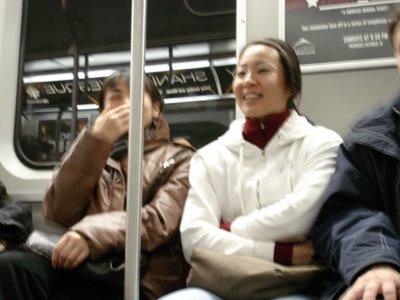
Also needless to say, the two girls sitting across from us were less than pleased.
I tried to backpeddle, saying "Well, it could be Greek food! Or... Israeli food! Bad Israeli food!!!"
"Nope, definately bad Chinese food!" Replied Dave
He hadn't looked across from us yet.
I had Chinese food for dinner last night.
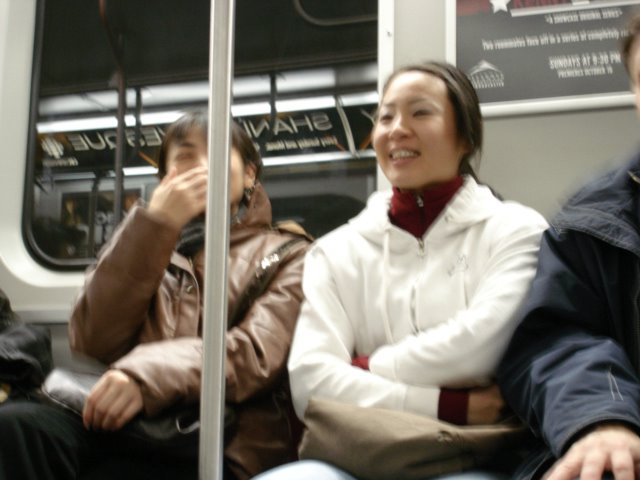
Also needless to say, the two girls sitting across from us were less than pleased.
I tried to backpeddle, saying "Well, it could be Greek food! Or... Israeli food! Bad Israeli food!!!"
"Nope, definately bad Chinese food!" Replied Dave
He hadn't looked across from us yet.
I had Chinese food for dinner last night.
Saturday, October 29, 2005
A conversation with Steve is never boring!
Jesse Juicy Jew: what are you flying (to Houston)?
stevenbuchalter: southwest from Detroit
Jesse Juicy Jew: oh
Jesse Juicy Jew: loser
stevenbuchalter: jew
Jesse Juicy Jew: man
stevenbuchalter: theatre major
Jesse Juicy Jew: guy who goes to western
stevenbuchalter: zionist
Jesse Juicy Jew: canadian
stevenbuchalter: shabbos-respecter
Jesse Juicy Jew: shabbos-defiler
stevenbuchalter: closet homosexual
Jesse Juicy Jew: public butt fucker
stevenbuchalter: hey that's not fair
stevenbuchalter: i haven't called you anything negative yet
stevenbuchalter: go up and check them all
Jesse Juicy Jew: who says butt fucking in public is negative?
stevenbuchalter: am i giving? or receiving
Jesse Juicy Jew: whatever floats your boat
Jesse Juicy Jew: you should fully know that this converstion is going to be published in my blog
stevenbuchalter: shouldn't you have said that before i started talking? that's not a very fair disclaimer
stevenbuchalter: also...if this is going in your blog
stevenbuchalter: pencildick!
stevenbuchalter: jesse has a pencildick!
Jesse Juicy Jew: if you can see my penis from London, I doubt that it's a pencildick
stevenbuchalter: i can...it's the thin snaking flaccid line running down our main streets
stevenbuchalter: with the signs that say "2 miles this way to the head of the world's longest thinnest dick"
stevenbuchalter: yeah how's that for your blog
stevenbuchalter: sorry...i'm on some drugs right now
Jesse Juicy Jew: good enough
Jesse Juicy Jew: thank you
stevenbuchalter: didn't mean to be a jerk
Jesse Juicy Jew: it's ok
Jesse Juicy Jew: you're wonderful
stevenbuchalter: i really do enjoy marijuana
stevenbuchalter: though it's no cocaine
stevenbuchalter: cocaine's a hell of a drug
stevenbuchalter: southwest from Detroit
Jesse Juicy Jew: oh
Jesse Juicy Jew: loser
stevenbuchalter: jew
Jesse Juicy Jew: man
stevenbuchalter: theatre major
Jesse Juicy Jew: guy who goes to western
stevenbuchalter: zionist
Jesse Juicy Jew: canadian
stevenbuchalter: shabbos-respecter
Jesse Juicy Jew: shabbos-defiler
stevenbuchalter: closet homosexual
Jesse Juicy Jew: public butt fucker
stevenbuchalter: hey that's not fair
stevenbuchalter: i haven't called you anything negative yet
stevenbuchalter: go up and check them all
Jesse Juicy Jew: who says butt fucking in public is negative?
stevenbuchalter: am i giving? or receiving
Jesse Juicy Jew: whatever floats your boat
Jesse Juicy Jew: you should fully know that this converstion is going to be published in my blog
stevenbuchalter: shouldn't you have said that before i started talking? that's not a very fair disclaimer
stevenbuchalter: also...if this is going in your blog
stevenbuchalter: pencildick!
stevenbuchalter: jesse has a pencildick!
Jesse Juicy Jew: if you can see my penis from London, I doubt that it's a pencildick
stevenbuchalter: i can...it's the thin snaking flaccid line running down our main streets
stevenbuchalter: with the signs that say "2 miles this way to the head of the world's longest thinnest dick"
stevenbuchalter: yeah how's that for your blog
stevenbuchalter: sorry...i'm on some drugs right now
Jesse Juicy Jew: good enough
Jesse Juicy Jew: thank you
stevenbuchalter: didn't mean to be a jerk
Jesse Juicy Jew: it's ok
Jesse Juicy Jew: you're wonderful
stevenbuchalter: i really do enjoy marijuana
stevenbuchalter: though it's no cocaine
stevenbuchalter: cocaine's a hell of a drug
Friday, October 14, 2005
What I'm fighting for...
THIS ARTICLE IS FROM HA'ARETZ
Reform Transforms
By Micha Odenheimer
Anyone looking at Melissa Simon, dressed in a denim skirt and sweater, walk by on a Jerusalem street would automatically assume she is one of the hundreds of young Orthodox women who have come to the holy city to study Torah.
They would be half right. Melissa is in Jerusalem this year to study Torah. But she is doing it under the auspices of the Hebrew Union College (HUC). In four years, after completing her studies at one of the college's U.S. campuses, she will graduate as an ordained Reform rabbi.
For Melissa, who speaks with the passionate self-confidence of a born teacher - tempered by a tendency to blush at her own displays of eloquence - dressing like a yeshiva girl is a "subversive" practice, a double-edged sword aimed at undermining the preconceptions of both Reform and Orthodox Jews.
Melissa actively campaigns for homosexual rights and abortion rights, and she is an ardent feminist. Yet, she says, "I decided several years ago, while in college, to reclaim tzniut, modesty, in dress and attitude, as a practice and value for the Reform movement. I found it made me think about Judaism every time I got dressed. That's a key part of the whole thing - to enlarge the picture of what being Jewish is about."
Melissa, who observes Shabbat and kashrut and is deeply interested in other areas of halakha that have been long-neglected by Reform, is part of a growing trend that has transformed the movement's avant garde and is redefining what it means to be a Reform Jew.
Although some of her classmates here for the year in rabbinical school still do not wear skullcaps, even while praying, and lament the hardship of living in a city where it is "difficult to find good shellfish," others wear skullcaps and even tzitzit - prayer shawls, even when they are not praying, and "are in heaven" because Jerusalem's multitude of kosher restaurants means they can finally eat out whenever they feel like it.
The movement as a whole has become welcoming and tolerant of halakhic observance, reversing a 150-year history in which Reform defined itself in part by its rejection of traditional practices. "Fifteen years ago," says Rabbi Rachel Sabath, who was one of the first HUC students to raise the flag of Reform's return to halakha, "I was told that I would have a hard time getting a job in the Reform movement, because I refused to do things like take the youth group to an amusement park on Saturday afternoon. But now I am embraced, hired and asked to speak in Reform congregations about my path as an observant yet Reform Jew. They'll go out of their way to accommodate me - I'm told, `We'll do it on Sunday,' or `We'll come to you.'"
A new openness to "the whole array of mitzvot," in the words of the 1999 Pittsburgh Statement, drafted by Reform rabbinic leaders as a deliberate repudiation of the movement's historic - and notorious - 1885 Pittsburgh Platform, has become part of the movement's official doctrine. Some Reform leaders see this sea change as a form of repentance, or teshuva.
Searching for the secret formula
In the past, says Rabbi Sheldon Zimmerman, who served as president of Hebrew Union College until 2001, Reform saw its task as radically transforming the Torah. The new task, he says, is changing the Jew. "Our starting point is that the Reform Jew of the beginning of the 21st century needs to be transformed," Zimmerman writes, in an essay called Transforming the Reform Jew. "Transform means to question and challenge the times in which we live. ... Transform means to accept Torah (in the broadest sense, in all its aspects) as the starting point of the encounter, to accept teshuva as the primary category for Jews in our time."
This tilt toward more traditional observance is only one aspect of the changes sweeping through the Reform movement as it renegotiates its relationship to modernity, to tradition and to Jewish peoplehood - all the while relentlessly searching for the secret formula or strategy that might stay the floodwaters of assimilation threatening much of their constituency.
Yet Orthodox ideologues would do well, for the moment, to quell triumphal cries in seeing Reform's religious ferment. For what is emerging from the Reform movement is something more subtle, complex and paradoxical than some form of Orthodox lite: a more self-confident and religiously alive form of liberal Judaism, closer to tradition, yet as subversive of our stereotypical assumptions about Jewish reality as the figure of future rabbi Melissa campaigning for homosexual rights looking for all the world like a modern Orthodox yeshiva girl.
To understood how far Reform has come, it is important to remember where it began. From its inception in Germany, in the early decades of the 19th century, Reform's embrace of modernity was nearly total. Rituals or beliefs that Reform leaders found irrational - and believed would impede Jewish acceptance in gentile society - were excised wholesale from the Reform repertoire, as a matter of principle. By 1883, the Reform movement in the United States had flamboyantly rejected the laws of kashrut. A dinner held in honor of the first graduating class of Hebrew Union College featured flagrantly non-kosher delicacies, and was recorded in the annals of history as the treife banquet. The Platform also rejected the notion of Jewish peoplehood; the Jews had once been a nation, it argued, but were now something more exalted - individuals united by a religion whose pure essence could be summed up in two words: ethical monotheism.
Replacing the commandments and Jewish people-hood was a powerful belief in science and progress, as well as in a God who ruled over a world evolving inexorably toward rationality and goodness. Perhaps most audaciously, the Reform movement believed that modernity itself contained the seeds of messianic fulfillment - the first flowering of the redemption. "We recognize, in the modern era," says the Pittsburgh Platform, "the approaching of the realization of Israel's great Messianic hope for the establishment of the kingdom of truth, justice and peace among all men."
Isaac Meyer Wise, the outstanding leader of American Reform Judaism during the last decades of the 19th century, believed that, purified of its primitive elements and distilled into its essence, Judaism would, within decades, become the religion of all humankind. Zionism was despised as a small-minded, nationalistic throwback.
According to Rabbi David Ellenson, the current president of HUC and a passionate Zionist, when Rabbi Kaufman Kohler became president of HUC at the beginning of the 20th century, "He fired every Zionist faculty member, and gave speeches to the students saying they could choose between the pure God of universal progress and love or the Godless nationalists."
Movement is virtually unrecognizable
The movement began to change its attitude toward Zionism in its 1937 Columbus Platform. But in its religious beliefs and practices, Reform remained, for many decades, largely static - Protestant in its aesthetic and style of worship. Services were mostly in English, and a professional cantor accompanied by a choir and organ sang the liturgy, while the worshipers remained seated and passive. Friday night worship was scheduled for after dinner, not at the traditional sunset hour. Congregants had little knowledge of Jewish sources. Even the rabbis, though eloquent and knowledgeable when it came to American politics and Western culture, were not necessarily Judaic scholars. "There are two kinds of Reform rabbis," one prominent mid-20th century Reform leader once quipped. "Those who believe in ethical monotheism, and those who know Hebrew."
But now, five years into the 21st century, the Reform movement - or at least some of it - has changed to such an extent as to be virtually unrecognizable. Bill Berk, a soft-spoken, engaging man in his mid-50s, is the rabbi of Temple Chai in Phoenix, Arizona, a Reform Temple that many in the movement say they look to as a model. The prayers, which are sung enthusiastically by the entire congregation, rather than by the cantor and choir, are in Hebrew. The services are scheduled for 6:15 P.M., approximating the sunset onset of Shabbat, as is traditional. Berk says that new worshipers who grew up with Classical Reform are often dumbfounded when they walk into his Friday night services. "They absolutely don't believe that it's Reform," he says.
What has catalyzed the changes that are redefining Reform, transforming it from the quintessentially modern religion it was into a new, postmodern era? The answer is multifaceted, with theological notions and sociological conditions fitting into each other like pieces in a jigsaw puzzle. One of the two or three most powerful leaders of Reform today, Ellenson, who was appointed president of HUC in 2001, is one of the finest minds studying the puzzle - and is also emblematic of the shifting face of the movement today. Ellenson was born and raised in an Orthodox family, and although he broke away from halakhic observance as a teenager, he is "obsessed" with his field of scholarly research: the impact of modernity on Orthodox ideology and halakha.
Ellenson is a student of Jacob Katz, the towering historian of the Jewish encounter with modernity who died in 1998. Until the modern period, Katz taught, Jews were part of a religious community with a separate political status in the societies they inhabited. Within their communities, the rabbis had the authority to impose communal norms. Emancipation gave individual Jews rights as citizens, dissolving the rabbi's coercive power. Orthodoxy, Reform and Conservative Jewry all grew out of the vacuum of power that was created, as they vied for individual hearts and minds. Reform embraced modernity and its freedom wholeheartedly, while Orthodoxy attempted to preserve the authority of halakha in the face of political change.
For several generations, Reform continued to benefit from the glue that kept Jews together even in the absence of religious tradition: remnants of tribal loyalties, the ongoing threat of anti-Semitism and lingering discomfort over Jewish identity in a Christian society, all of which made intermarriage rare. But in recent years, the glue has melted away. "The issue today," says Ellenson, a warm, genial man with a trim beard, who says that until he became president of HUC he would go to work in blue jeans, "is what to do when you have a fifth and sixth generation American Jewish community that is totally acculturated, when Jews can be officers in companies like DuPont, or presidents of Ivy League universities?" As Rabbi Naama Kelman, associate dean of Hebrew Union College in Israel puts it, speaking of American Jews, "We no longer have to keep up with the Joneses. We are the Joneses."
And yet, as Reform Judaism has learned to its surprise, modernity cuts both ways. "What you see," Ellenson says, "is that modernity destroys tradition, but, at the same time, it makes people seek tradition, so that what you have in America today are trends that move in opposite directions." In the often cold and impersonal contemporary society, Judaism has "vast reservoirs of meaning" to offer. Ellenson says he is open to "the full range of how Jewish spirituality is expressed in our times" - and that definitely includes halakha. "Halakha is the idiomatic way in which Judaism spoke and continues to speak. If you want to talk about the possibility of creating meaning, you have to look at halakhic sources."
But openness to halakha does not mean a return to Orthodox notions of commitment. A recent, influential study of the postmodern Jewish self called "The Inner Jew," written by Israeli sociologist Steven Cohen and Stanford historian Arnold Eisen, paints a portrait of the contemporary American Jew as still connected to Judaism, but on his or her own terms. "Personal meaning," the study concludes, has become "the arbiter of their Jewish involvement. Jews are focused on the self and its fulfillment, rather than directed outward to the group. With the valorization of tradition, the absolute commitment to pluralism and the continuing assumption of individual autonomy, [Jews] feel free to borrow selectively, and perhaps only temporarily, from traditional Jewish religious and cultural sources."
Ellenson sees the significance of halakha and Torah learning in their capacity to produce a web of meaning and memory that can sustain Jewish identity. "Too many people think in binary categories of forbidden and permitted," he says. "We would do better to think in categories of meaning." Although he is endearingly apologetic about it - "I don't know whether it's an emotional or an intellectual problem" - Ellenson admits he is not personally interested in theology and is agnostic about most ultimate questions.
But for other Reform Jews, like Rabbi Rachel Sabath and Rabbi Leon Morris, head of the Skirball Center for Adult Jewish Learning in New York City, observance does emerge from ultimate concerns. With the messianic hope Reform placed in modernity shattered by the Holocaust, says Sabath, "There is a need and a place for the commanding voice of God outside of human capacity and anything that could stem from reason."
Rate of intermarriage has skyrocketed
Sabath and Morris are both students of Rabbi Eugene Borowitz, the preeminent Reform theologian, who argued for the spiritual necessity of an ongoing inner struggle in which the transcendent voice of God is filtered through our own autonomous ethical sensibility. "What I would like to turn on its head," says Morris, "is that the burden of proof is on the tradition itself - Reform Jews have the right to reject a specific tradition after studying and wrestling with it, and finding it ethically untenable, but the default position is that I have to observe this, it has come down this way, these commandments have a claim on me as a Jew."
The place where the future of the Reform movement will really be decided is in its version of the trenches - in the congregations scattered across America that serve the movement's more than 1 million members. American Jewry, and the Reform movement in particular, were traumatized in 1990 when a population survey showed that the rate of intermarriage had skyrocketed over the last 30 years from about 6 percent to more than 50 percent. In the past, Reform's desire to keep and expand its constituency of highly assimilated Jews - unofficial estimates say 30 percent of Reform congregants are intermarried - has meant a hesitancy to make demands in terms of knowledge or practice.
But in an era of spiritual search, many Reform rabbis have begun to realize that a call for greater commitment and involvement may have a far wider appeal than they once thought. Rabbi Bill Berk of Temple Chai, where hundreds of Jews pack Shabbat services and participate in often- intensive ongoing programs, believes that demanding higher levels of commitment has helped create a more vibrant community. "You have to have a sense of the mitzvah as something coming from the outside so that you don't get yanked away by each passing breeze of the modern world. Living in modernity there are a lot of wounds - unbridled competition, the impact of media, the whole underside of capitalism. If you can be part of a real community, you can survive the shallow side of America."
In a sermon delivered a year ago, Rabbi Janet Marder, currently the president of the CCAR, Reform's rabbinic organization, succinctly expressed the critique of Reform's past, which has caused a return to more traditional forms of ritual and prayer.
"Speaking to God in polite paragraphs of good English prose, or figuring God out of the equation altogether and making worship a purely cerebral act of self-evaluation - these are not activities compelling enough to make many people today opt for Friday night worship rather than a good dinner and a movie." In her address, she spoke about Eileen, a congregant who had recently lost her husband and then discovered that she herself was ill with Parkinson's disease. "Reducing Judaism to an arid core of reasoned principles or generic moral virtues that we share with good people of all faiths, stripping it of its color and vitality and emotional force - these are not enough for Eileen, whose world is collapsing around her. If we have nothing of significance to offer a woman like her, who craves an experience of spiritual sustenance and meaning, then we have nothing of real value to offer the world."
Reform Transforms
By Micha Odenheimer
Anyone looking at Melissa Simon, dressed in a denim skirt and sweater, walk by on a Jerusalem street would automatically assume she is one of the hundreds of young Orthodox women who have come to the holy city to study Torah.
They would be half right. Melissa is in Jerusalem this year to study Torah. But she is doing it under the auspices of the Hebrew Union College (HUC). In four years, after completing her studies at one of the college's U.S. campuses, she will graduate as an ordained Reform rabbi.
For Melissa, who speaks with the passionate self-confidence of a born teacher - tempered by a tendency to blush at her own displays of eloquence - dressing like a yeshiva girl is a "subversive" practice, a double-edged sword aimed at undermining the preconceptions of both Reform and Orthodox Jews.
Melissa actively campaigns for homosexual rights and abortion rights, and she is an ardent feminist. Yet, she says, "I decided several years ago, while in college, to reclaim tzniut, modesty, in dress and attitude, as a practice and value for the Reform movement. I found it made me think about Judaism every time I got dressed. That's a key part of the whole thing - to enlarge the picture of what being Jewish is about."
Melissa, who observes Shabbat and kashrut and is deeply interested in other areas of halakha that have been long-neglected by Reform, is part of a growing trend that has transformed the movement's avant garde and is redefining what it means to be a Reform Jew.
Although some of her classmates here for the year in rabbinical school still do not wear skullcaps, even while praying, and lament the hardship of living in a city where it is "difficult to find good shellfish," others wear skullcaps and even tzitzit - prayer shawls, even when they are not praying, and "are in heaven" because Jerusalem's multitude of kosher restaurants means they can finally eat out whenever they feel like it.
The movement as a whole has become welcoming and tolerant of halakhic observance, reversing a 150-year history in which Reform defined itself in part by its rejection of traditional practices. "Fifteen years ago," says Rabbi Rachel Sabath, who was one of the first HUC students to raise the flag of Reform's return to halakha, "I was told that I would have a hard time getting a job in the Reform movement, because I refused to do things like take the youth group to an amusement park on Saturday afternoon. But now I am embraced, hired and asked to speak in Reform congregations about my path as an observant yet Reform Jew. They'll go out of their way to accommodate me - I'm told, `We'll do it on Sunday,' or `We'll come to you.'"
A new openness to "the whole array of mitzvot," in the words of the 1999 Pittsburgh Statement, drafted by Reform rabbinic leaders as a deliberate repudiation of the movement's historic - and notorious - 1885 Pittsburgh Platform, has become part of the movement's official doctrine. Some Reform leaders see this sea change as a form of repentance, or teshuva.
Searching for the secret formula
In the past, says Rabbi Sheldon Zimmerman, who served as president of Hebrew Union College until 2001, Reform saw its task as radically transforming the Torah. The new task, he says, is changing the Jew. "Our starting point is that the Reform Jew of the beginning of the 21st century needs to be transformed," Zimmerman writes, in an essay called Transforming the Reform Jew. "Transform means to question and challenge the times in which we live. ... Transform means to accept Torah (in the broadest sense, in all its aspects) as the starting point of the encounter, to accept teshuva as the primary category for Jews in our time."
This tilt toward more traditional observance is only one aspect of the changes sweeping through the Reform movement as it renegotiates its relationship to modernity, to tradition and to Jewish peoplehood - all the while relentlessly searching for the secret formula or strategy that might stay the floodwaters of assimilation threatening much of their constituency.
Yet Orthodox ideologues would do well, for the moment, to quell triumphal cries in seeing Reform's religious ferment. For what is emerging from the Reform movement is something more subtle, complex and paradoxical than some form of Orthodox lite: a more self-confident and religiously alive form of liberal Judaism, closer to tradition, yet as subversive of our stereotypical assumptions about Jewish reality as the figure of future rabbi Melissa campaigning for homosexual rights looking for all the world like a modern Orthodox yeshiva girl.
To understood how far Reform has come, it is important to remember where it began. From its inception in Germany, in the early decades of the 19th century, Reform's embrace of modernity was nearly total. Rituals or beliefs that Reform leaders found irrational - and believed would impede Jewish acceptance in gentile society - were excised wholesale from the Reform repertoire, as a matter of principle. By 1883, the Reform movement in the United States had flamboyantly rejected the laws of kashrut. A dinner held in honor of the first graduating class of Hebrew Union College featured flagrantly non-kosher delicacies, and was recorded in the annals of history as the treife banquet. The Platform also rejected the notion of Jewish peoplehood; the Jews had once been a nation, it argued, but were now something more exalted - individuals united by a religion whose pure essence could be summed up in two words: ethical monotheism.
Replacing the commandments and Jewish people-hood was a powerful belief in science and progress, as well as in a God who ruled over a world evolving inexorably toward rationality and goodness. Perhaps most audaciously, the Reform movement believed that modernity itself contained the seeds of messianic fulfillment - the first flowering of the redemption. "We recognize, in the modern era," says the Pittsburgh Platform, "the approaching of the realization of Israel's great Messianic hope for the establishment of the kingdom of truth, justice and peace among all men."
Isaac Meyer Wise, the outstanding leader of American Reform Judaism during the last decades of the 19th century, believed that, purified of its primitive elements and distilled into its essence, Judaism would, within decades, become the religion of all humankind. Zionism was despised as a small-minded, nationalistic throwback.
According to Rabbi David Ellenson, the current president of HUC and a passionate Zionist, when Rabbi Kaufman Kohler became president of HUC at the beginning of the 20th century, "He fired every Zionist faculty member, and gave speeches to the students saying they could choose between the pure God of universal progress and love or the Godless nationalists."
Movement is virtually unrecognizable
The movement began to change its attitude toward Zionism in its 1937 Columbus Platform. But in its religious beliefs and practices, Reform remained, for many decades, largely static - Protestant in its aesthetic and style of worship. Services were mostly in English, and a professional cantor accompanied by a choir and organ sang the liturgy, while the worshipers remained seated and passive. Friday night worship was scheduled for after dinner, not at the traditional sunset hour. Congregants had little knowledge of Jewish sources. Even the rabbis, though eloquent and knowledgeable when it came to American politics and Western culture, were not necessarily Judaic scholars. "There are two kinds of Reform rabbis," one prominent mid-20th century Reform leader once quipped. "Those who believe in ethical monotheism, and those who know Hebrew."
But now, five years into the 21st century, the Reform movement - or at least some of it - has changed to such an extent as to be virtually unrecognizable. Bill Berk, a soft-spoken, engaging man in his mid-50s, is the rabbi of Temple Chai in Phoenix, Arizona, a Reform Temple that many in the movement say they look to as a model. The prayers, which are sung enthusiastically by the entire congregation, rather than by the cantor and choir, are in Hebrew. The services are scheduled for 6:15 P.M., approximating the sunset onset of Shabbat, as is traditional. Berk says that new worshipers who grew up with Classical Reform are often dumbfounded when they walk into his Friday night services. "They absolutely don't believe that it's Reform," he says.
What has catalyzed the changes that are redefining Reform, transforming it from the quintessentially modern religion it was into a new, postmodern era? The answer is multifaceted, with theological notions and sociological conditions fitting into each other like pieces in a jigsaw puzzle. One of the two or three most powerful leaders of Reform today, Ellenson, who was appointed president of HUC in 2001, is one of the finest minds studying the puzzle - and is also emblematic of the shifting face of the movement today. Ellenson was born and raised in an Orthodox family, and although he broke away from halakhic observance as a teenager, he is "obsessed" with his field of scholarly research: the impact of modernity on Orthodox ideology and halakha.
Ellenson is a student of Jacob Katz, the towering historian of the Jewish encounter with modernity who died in 1998. Until the modern period, Katz taught, Jews were part of a religious community with a separate political status in the societies they inhabited. Within their communities, the rabbis had the authority to impose communal norms. Emancipation gave individual Jews rights as citizens, dissolving the rabbi's coercive power. Orthodoxy, Reform and Conservative Jewry all grew out of the vacuum of power that was created, as they vied for individual hearts and minds. Reform embraced modernity and its freedom wholeheartedly, while Orthodoxy attempted to preserve the authority of halakha in the face of political change.
For several generations, Reform continued to benefit from the glue that kept Jews together even in the absence of religious tradition: remnants of tribal loyalties, the ongoing threat of anti-Semitism and lingering discomfort over Jewish identity in a Christian society, all of which made intermarriage rare. But in recent years, the glue has melted away. "The issue today," says Ellenson, a warm, genial man with a trim beard, who says that until he became president of HUC he would go to work in blue jeans, "is what to do when you have a fifth and sixth generation American Jewish community that is totally acculturated, when Jews can be officers in companies like DuPont, or presidents of Ivy League universities?" As Rabbi Naama Kelman, associate dean of Hebrew Union College in Israel puts it, speaking of American Jews, "We no longer have to keep up with the Joneses. We are the Joneses."
And yet, as Reform Judaism has learned to its surprise, modernity cuts both ways. "What you see," Ellenson says, "is that modernity destroys tradition, but, at the same time, it makes people seek tradition, so that what you have in America today are trends that move in opposite directions." In the often cold and impersonal contemporary society, Judaism has "vast reservoirs of meaning" to offer. Ellenson says he is open to "the full range of how Jewish spirituality is expressed in our times" - and that definitely includes halakha. "Halakha is the idiomatic way in which Judaism spoke and continues to speak. If you want to talk about the possibility of creating meaning, you have to look at halakhic sources."
But openness to halakha does not mean a return to Orthodox notions of commitment. A recent, influential study of the postmodern Jewish self called "The Inner Jew," written by Israeli sociologist Steven Cohen and Stanford historian Arnold Eisen, paints a portrait of the contemporary American Jew as still connected to Judaism, but on his or her own terms. "Personal meaning," the study concludes, has become "the arbiter of their Jewish involvement. Jews are focused on the self and its fulfillment, rather than directed outward to the group. With the valorization of tradition, the absolute commitment to pluralism and the continuing assumption of individual autonomy, [Jews] feel free to borrow selectively, and perhaps only temporarily, from traditional Jewish religious and cultural sources."
Ellenson sees the significance of halakha and Torah learning in their capacity to produce a web of meaning and memory that can sustain Jewish identity. "Too many people think in binary categories of forbidden and permitted," he says. "We would do better to think in categories of meaning." Although he is endearingly apologetic about it - "I don't know whether it's an emotional or an intellectual problem" - Ellenson admits he is not personally interested in theology and is agnostic about most ultimate questions.
But for other Reform Jews, like Rabbi Rachel Sabath and Rabbi Leon Morris, head of the Skirball Center for Adult Jewish Learning in New York City, observance does emerge from ultimate concerns. With the messianic hope Reform placed in modernity shattered by the Holocaust, says Sabath, "There is a need and a place for the commanding voice of God outside of human capacity and anything that could stem from reason."
Rate of intermarriage has skyrocketed
Sabath and Morris are both students of Rabbi Eugene Borowitz, the preeminent Reform theologian, who argued for the spiritual necessity of an ongoing inner struggle in which the transcendent voice of God is filtered through our own autonomous ethical sensibility. "What I would like to turn on its head," says Morris, "is that the burden of proof is on the tradition itself - Reform Jews have the right to reject a specific tradition after studying and wrestling with it, and finding it ethically untenable, but the default position is that I have to observe this, it has come down this way, these commandments have a claim on me as a Jew."
The place where the future of the Reform movement will really be decided is in its version of the trenches - in the congregations scattered across America that serve the movement's more than 1 million members. American Jewry, and the Reform movement in particular, were traumatized in 1990 when a population survey showed that the rate of intermarriage had skyrocketed over the last 30 years from about 6 percent to more than 50 percent. In the past, Reform's desire to keep and expand its constituency of highly assimilated Jews - unofficial estimates say 30 percent of Reform congregants are intermarried - has meant a hesitancy to make demands in terms of knowledge or practice.
But in an era of spiritual search, many Reform rabbis have begun to realize that a call for greater commitment and involvement may have a far wider appeal than they once thought. Rabbi Bill Berk of Temple Chai, where hundreds of Jews pack Shabbat services and participate in often- intensive ongoing programs, believes that demanding higher levels of commitment has helped create a more vibrant community. "You have to have a sense of the mitzvah as something coming from the outside so that you don't get yanked away by each passing breeze of the modern world. Living in modernity there are a lot of wounds - unbridled competition, the impact of media, the whole underside of capitalism. If you can be part of a real community, you can survive the shallow side of America."
In a sermon delivered a year ago, Rabbi Janet Marder, currently the president of the CCAR, Reform's rabbinic organization, succinctly expressed the critique of Reform's past, which has caused a return to more traditional forms of ritual and prayer.
"Speaking to God in polite paragraphs of good English prose, or figuring God out of the equation altogether and making worship a purely cerebral act of self-evaluation - these are not activities compelling enough to make many people today opt for Friday night worship rather than a good dinner and a movie." In her address, she spoke about Eileen, a congregant who had recently lost her husband and then discovered that she herself was ill with Parkinson's disease. "Reducing Judaism to an arid core of reasoned principles or generic moral virtues that we share with good people of all faiths, stripping it of its color and vitality and emotional force - these are not enough for Eileen, whose world is collapsing around her. If we have nothing of significance to offer a woman like her, who craves an experience of spiritual sustenance and meaning, then we have nothing of real value to offer the world."
Monday, June 13, 2005
Reaching me in Israel
If you'd like to call me in Israel, dial this number EXACTLY AS SHOWN:
011-972-52-604-1592
This is assuming you live in North America. If you're calling from Israel, you know how to reach me.
If you're emailing, please don't use the @yorku.ca address, use the @gmail.com address.
Have a great summer everyone!
011-972-52-604-1592
This is assuming you live in North America. If you're calling from Israel, you know how to reach me.
If you're emailing, please don't use the @yorku.ca address, use the @gmail.com address.
Have a great summer everyone!
Thursday, May 26, 2005
currently experiences technical difficulties
I've been off for a while, and will continue to be off until my time in Israel this summer, at which point this will serve as my trip journal. See you then.
~j
~j
Wednesday, March 30, 2005
where does the time go when it's not around here?
it's been a month and a half since I've found the time to post. I largely blame it on my submission to the theatre. I remember Janette, one of my theatre teachers in high school used to believe in the theatre spirits/gods/pixies/insertyourfavouritemythicalcreaturehere. Well if she believes that they really exist, then I belive that there exists some sort of theatre purgatory where people slip into during shows. I swear - Ruddigore took a giant bite out of three months of my life, chewed on it, sucked on it, then spat it out in a glory of theatrical wonder.
now don't get me wrong - the show was fantastic, the cast was fantastic - everything was... fantastic. BUT WHERE DID THOSE THREE MONTHS GO? HONESTLY?
the interesting side effect of it is that you delve so deep into the world, that you forget that everyone outside isn't watching your every move (a common feeling when you're an actor) so you wonder why they bitch and cry "WHERE HAVE YOU BEEN FOR THREE MONTHS?"
my response: "uhh... I moved into the theatre. yeah... i live under the stage.... in a box"
Yes it's true.... life does go on when you're not looking.
I keep asking myself why I didn't decide to study theatre in university. In retrospect, it's been great studying philosophy and religion - I've amassed a great amount of knowledge. BUT I think I would have amassed a huge amount more of life experience if I had been studying theatre.
It's been beautiful working with vcp, but I feel like I need a more disciplined experience. Now contrast that with my desire to become a Rabbi. People keep saying that they are two careers that compliment each other nicely - Rabbi's need to know how to "perform," they say... so I should do well, they say.
But there's this giant magnet in the theatre that pulls me towards it. I can't escape my desire to always live life on the Stage. capital "S"
To make it all the more complicated - would I have it any other way? - acting is not the only profession I'd see myself pursuing. Lighting and production design have also come to the forefront of my theatre fortes. WHAT TO DO?
I think it's time some of Janette's theatre spirits send me an epiphany.
In the meantime, I'll be looking at the National Theatre School after I graduate York. I know I'm not heading straight to HUC, so NTS might be a nice stop on the way. Or a permanent stop...?
now don't get me wrong - the show was fantastic, the cast was fantastic - everything was... fantastic. BUT WHERE DID THOSE THREE MONTHS GO? HONESTLY?
the interesting side effect of it is that you delve so deep into the world, that you forget that everyone outside isn't watching your every move (a common feeling when you're an actor) so you wonder why they bitch and cry "WHERE HAVE YOU BEEN FOR THREE MONTHS?"
my response: "uhh... I moved into the theatre. yeah... i live under the stage.... in a box"
Yes it's true.... life does go on when you're not looking.
I keep asking myself why I didn't decide to study theatre in university. In retrospect, it's been great studying philosophy and religion - I've amassed a great amount of knowledge. BUT I think I would have amassed a huge amount more of life experience if I had been studying theatre.
It's been beautiful working with vcp, but I feel like I need a more disciplined experience. Now contrast that with my desire to become a Rabbi. People keep saying that they are two careers that compliment each other nicely - Rabbi's need to know how to "perform," they say... so I should do well, they say.
But there's this giant magnet in the theatre that pulls me towards it. I can't escape my desire to always live life on the Stage. capital "S"
To make it all the more complicated - would I have it any other way? - acting is not the only profession I'd see myself pursuing. Lighting and production design have also come to the forefront of my theatre fortes. WHAT TO DO?
I think it's time some of Janette's theatre spirits send me an epiphany.
In the meantime, I'll be looking at the National Theatre School after I graduate York. I know I'm not heading straight to HUC, so NTS might be a nice stop on the way. Or a permanent stop...?
Friday, February 11, 2005
L'Kayitz Haba'ah B'Yisrael
So I just found out that I'll be spending this summer in Israel staffing a NFTY trip as Rosh T'fillah! Needless to say, Jesse is very excited... but I find this part of me is tingling to go back to Kutz. I definately will be in Israel - I think it's the job of a lifetime... but man do I miss camp.
Damn you Joni Mitchell and your "don't know what you've got 'till it's gone." You're so right, and it hurts.
Damn you Joni Mitchell and your "don't know what you've got 'till it's gone." You're so right, and it hurts.
Tonight was a great night
Tonight was a great night. It's good to get drunk with good friends and sing Moxy Fruvous at 2 in the morning. I think it's really healthy - a catharsis of sorts. If songs that Moxy Fruvous wrote 12 years ago are able to help me release the stresses of the week (that and six pints of beer and a shot of Tequila) then I can go to sleep content that it's been a great night.
Thank you friends, you've made it a truly good day!
Thank you friends, you've made it a truly good day!
Monday, February 07, 2005
Sunday, February 06, 2005
wrestling with God
I spent the greater part of my day trying to wrestle with God. Not in the Jacob wrestling with God sense, but in the Jesse wrestling with his concept of God sense. Rabbi Elyse Goldstein is the scholar-in-residence at Shul this weekend, and she lead a really interesting lunch session on God concepts. Thinking about God is like thinking about infiniti, you can do it, but it really hurts sometimes. I find that the more I think about God, the more I realize I don't even know where to begin. But Rabbi Elyse said something this morning that really jumped out at me.
She said something along the lines of.... "It's very hard for me to think of God and how God exists in this world, but it's even harder for me to think of a world where God doesn't exist."
I think that I've always believed in God. I don't really remember a time where I didn't. But at that point this morning, I had this connection with my understanding of God that I've never really had before. I realized how scary it is for me to imagine a world where God doesn't exist and where God doesn't play an integral role in existence. I just can't wrap my mind around it. As difficult as it is for me to wrap my mind around the very idea of God, it's terrifying for me to even try to wrap my mind around the notion of a Godless world.
Of course I respect all people's approaches to God... everybody needs to come to the point where they meet what works for them. But in all honesty, I just don't understand atheists. I don't know how you can't look around this world and see God in everything. I don't know how you could imagine that everything that is came to be by accident. Please, somebody explain to me how that could be possible.
So that's been following me around all day. It's a part of my greater transformation and growth Jewishly as of late. I find myself wanting to know more/do more/learn more/experience more, but not necessarily knowing exactly how I want to go about doing these things. What I am certain of is that I'm frustrated and disenchanted with a lot of Reform Judaism. At the same time, I find it hard to imagine being anything other than a Reform Jew. I've had this talk with plenty of people, and I know that I'm not the only one thirsty for more.
What disturbs me is that it's come to the point where I feel more spiritual, more Jewish, and like I can be a better Jew when I'm with a group of people from Kesher (like last weekend in Miami), or with a group of Conservative/Orthodox Jews, than when I'm at my own shul (where I've been a member for almost 14 years). It shouldn't be this way.
Is this just displaced teenage angst surfacing five years later in Jewish form?
Do I dare ask the cliche existential question: Am I the only one? Cause I know that I'm not.
I know that I will change, and that I will find what works for me, and that I will grow as a result of all this. I just wish I didn't have to be angry at what's been an integral part of me for 13 years.
That being said, I did have a lovely and restful Shabbat. To top it off, I'm going to bed!
She said something along the lines of.... "It's very hard for me to think of God and how God exists in this world, but it's even harder for me to think of a world where God doesn't exist."
I think that I've always believed in God. I don't really remember a time where I didn't. But at that point this morning, I had this connection with my understanding of God that I've never really had before. I realized how scary it is for me to imagine a world where God doesn't exist and where God doesn't play an integral role in existence. I just can't wrap my mind around it. As difficult as it is for me to wrap my mind around the very idea of God, it's terrifying for me to even try to wrap my mind around the notion of a Godless world.
Of course I respect all people's approaches to God... everybody needs to come to the point where they meet what works for them. But in all honesty, I just don't understand atheists. I don't know how you can't look around this world and see God in everything. I don't know how you could imagine that everything that is came to be by accident. Please, somebody explain to me how that could be possible.
So that's been following me around all day. It's a part of my greater transformation and growth Jewishly as of late. I find myself wanting to know more/do more/learn more/experience more, but not necessarily knowing exactly how I want to go about doing these things. What I am certain of is that I'm frustrated and disenchanted with a lot of Reform Judaism. At the same time, I find it hard to imagine being anything other than a Reform Jew. I've had this talk with plenty of people, and I know that I'm not the only one thirsty for more.
What disturbs me is that it's come to the point where I feel more spiritual, more Jewish, and like I can be a better Jew when I'm with a group of people from Kesher (like last weekend in Miami), or with a group of Conservative/Orthodox Jews, than when I'm at my own shul (where I've been a member for almost 14 years). It shouldn't be this way.
Is this just displaced teenage angst surfacing five years later in Jewish form?
Do I dare ask the cliche existential question: Am I the only one? Cause I know that I'm not.
I know that I will change, and that I will find what works for me, and that I will grow as a result of all this. I just wish I didn't have to be angry at what's been an integral part of me for 13 years.
That being said, I did have a lovely and restful Shabbat. To top it off, I'm going to bed!
Tuesday, February 01, 2005
Continuing my thievery of cool quotes from people's AOL profiles...
A kid goes to his dad and asks, "Dad, what are politics?"
His dad replies, " Put it this way; I am the breadwinner of the family so I am capitalism. Your mom is the owner of the money so she is government. The government is the provider for the people so you are the people. Your baby brother will be the future, and the nanny is the working class. Now think about that."
So he went to bed. He was woken by his brother. The baby had pooped in his diaper. He went to tell his parents, but he only found his mom asleep in the bed. He didn't want to wake her, so he went to the nanny. The door was locked. He checked through a hole and saw the dad in bed with the nanny.
The next morning, he went to his dad and said, "Dad I know what you mean now...
While capitalism is screwing the working class, the government is sound asleep, while the people are watching the future being pooped on."
His dad replies, " Put it this way; I am the breadwinner of the family so I am capitalism. Your mom is the owner of the money so she is government. The government is the provider for the people so you are the people. Your baby brother will be the future, and the nanny is the working class. Now think about that."
So he went to bed. He was woken by his brother. The baby had pooped in his diaper. He went to tell his parents, but he only found his mom asleep in the bed. He didn't want to wake her, so he went to the nanny. The door was locked. He checked through a hole and saw the dad in bed with the nanny.
The next morning, he went to his dad and said, "Dad I know what you mean now...
While capitalism is screwing the working class, the government is sound asleep, while the people are watching the future being pooped on."
Subscribe to:
Posts (Atom)
